

AI COGNITIVE ROBOTICS FOR UNDERWATER MANAGEMENT
The underwater eyes of your infrastructure.
Serenitech is an AI cognitive robotics company for the underwater management of critical infrastructure — ports, offshore platforms, subsea structures and the naval industry. Our cognitive robotic units perceive sub-surface physical phenomena — acoustics, vibration, structural motion, bathymetry and hydrodynamics — reason at the edge and act, delivering real-time operational data as a secure cloud service. Behind them: three decades of research in underwater telecommunications, sensors and embedded AI.
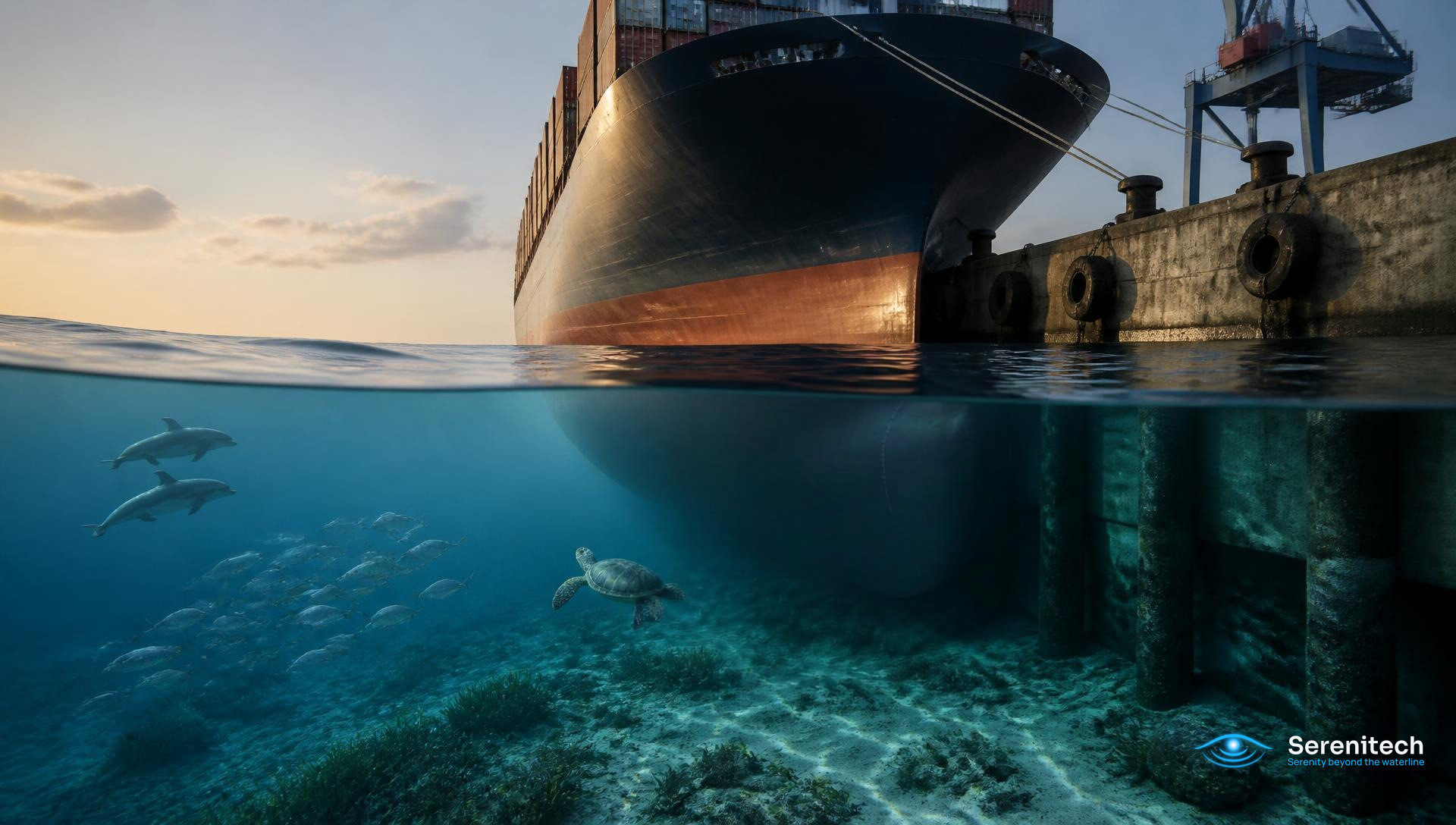
- Ports & terminals
- Offshore oil & gas
- Subsea structures
- Naval industry
- Monaco
- Brazil
- USA
THE PROBLEM
Critical infrastructure depends on what happens under water. Almost none of it is supervised continuously, online.
- 01
Depth is decided on old data.
Under-keel clearance, siltation and dredging priorities still rely on periodic surveys — while the channel changes every tide.
- 02
Impacts and fatigue leave no record.
Berthing collisions, vibration and structural drift on critical structures — piers, dolphins, jacket legs — go unmeasured until a repair, or a dispute.
- 03
Blind spots in security and compliance.
Vessels without AIS, underwater noise limits and environmental reporting are managed without continuous sub-surface evidence.
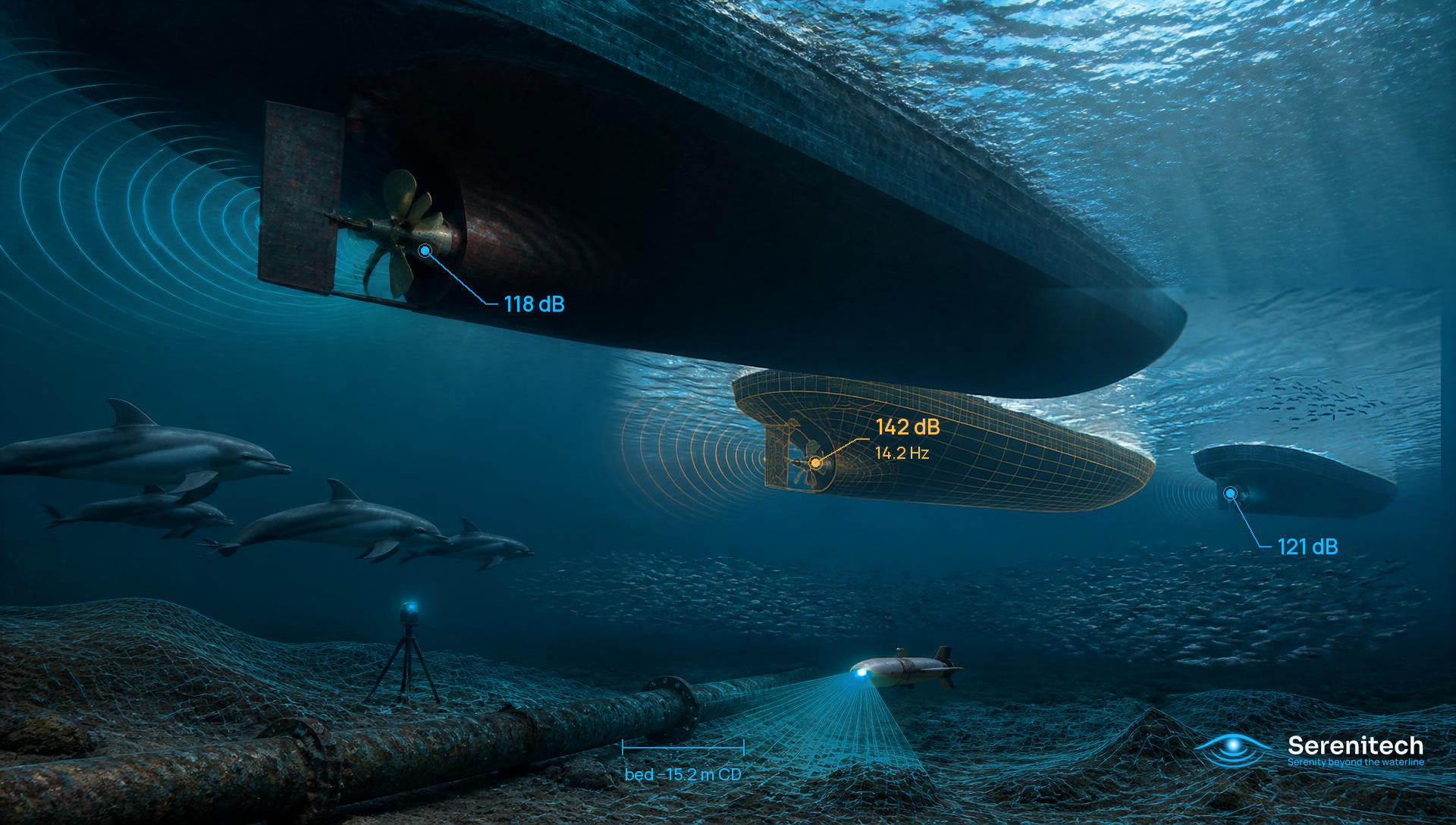
EVERY VESSEL LEAVES A SIGNATURE
Perceived at the channel bottom. Judged against the specification.
Our cognitive robotic units capture the acoustic, hydrodynamic and structural interference of every vessel that transits, compare it with the port's specification and flag the ones that exceed it — including the ones that harm fish and marine mammals.
- Within specification
- Out of specification — flagged
THE SOLUTION
One cognitive service. Four sub-surface domains.
Serenitech fuses hydro-acoustic arrays, structural mechanical fields, multi-directional hydrodynamic gradients, acoustic echo-sounding and water-column sensing into a single operational canvas. All instrumentation is encapsulated under abstract functional layers: you consume data, alerts and a digital twin — not hardware.
Hydro-acoustics
sound pressure, spectra, signatures
Structural mechanics
vibration, displacement, impacts
Hydrodynamics & bathymetry
depth, sediment, flow, draft
Water column
temperature, salinity, turbidity, sound speed
AI COGNITIVE ROBOTICS
Perceive. Reason. Act.
- 01
Perceive
Cognitive robotic units — fixed and mobile, underwater and on the surface — sense the hydro-acoustic, structural and hydrodynamic fields around your critical infrastructure, continuously.
- 02
Reason
Frugal, physics-informed AI runs inside each unit: it classifies signatures, detects anomalies and adapts its own sampling — with or without a live link to shore.
- 03
Act
Units raise alerts, cross-verify each other's readings and feed the cloud cognitive engine that fuses every unit into one operational picture: APIs, dashboards and the 3D digital twin.
FIELD VIEWS
What the cognitive units see.
Scenes from the domains we instrument — channel bottoms, quay walls, offshore structures, subsea assets and the hulls above them — with the measurements, sensor nodes and wavefronts our system produces. Open any image to see the detail.
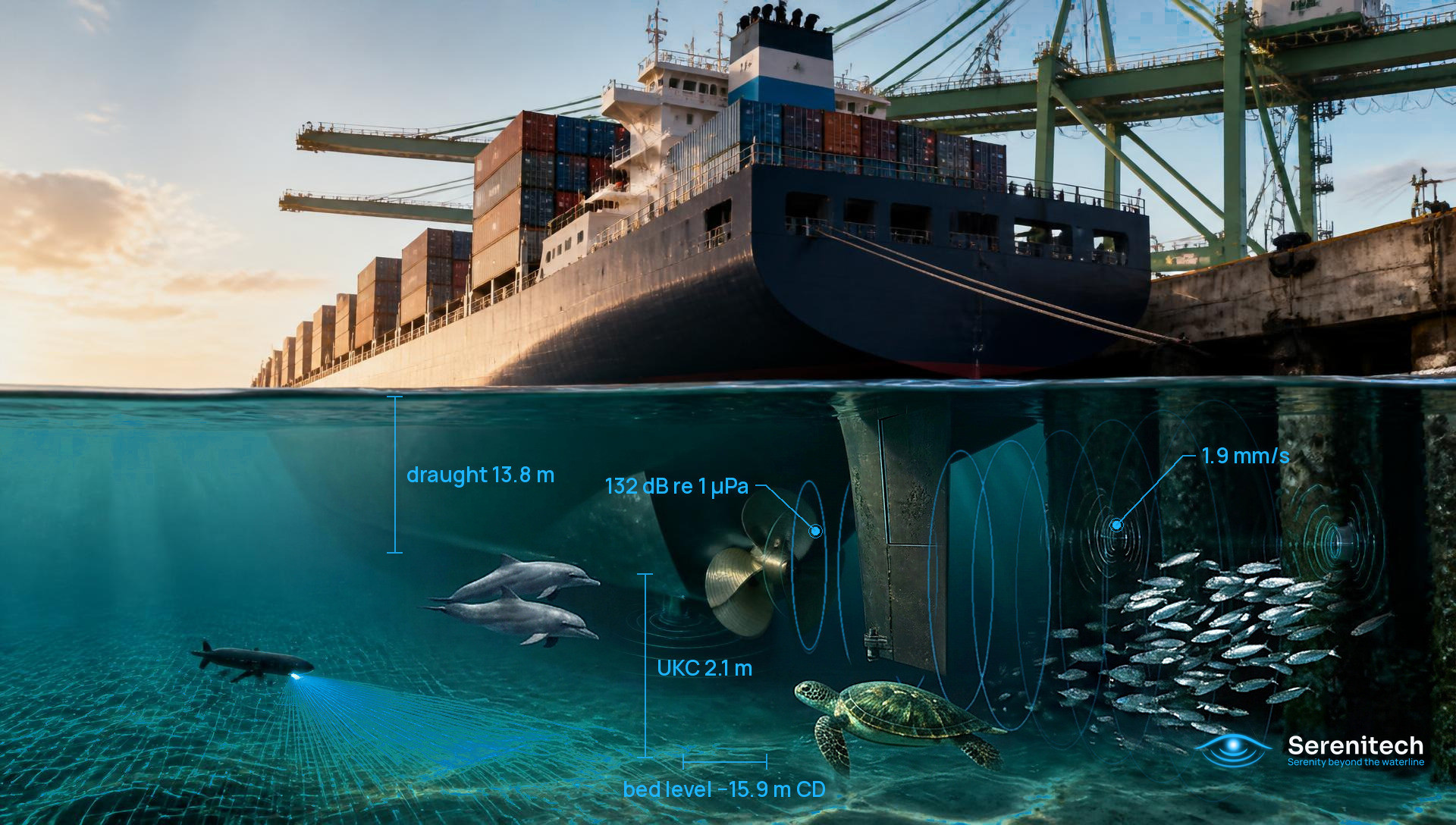
01Quay wall and moored container ship — under-keel clearance, berthing loads and the propeller's acoustic wavefronts. 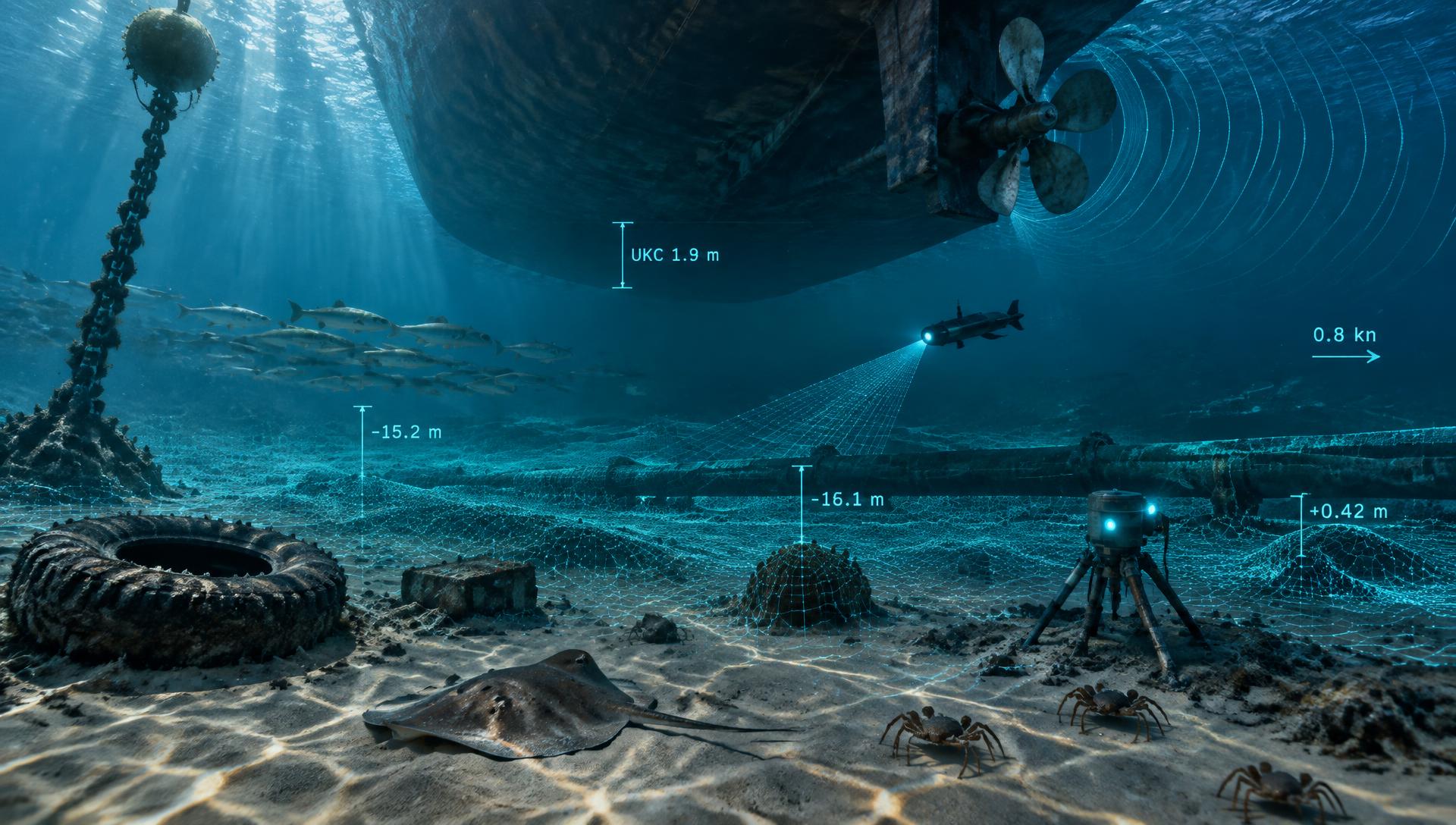
02Channel bottom under a transiting vessel — bathymetric surface, dynamic draft and the propeller-and-rudder signature. 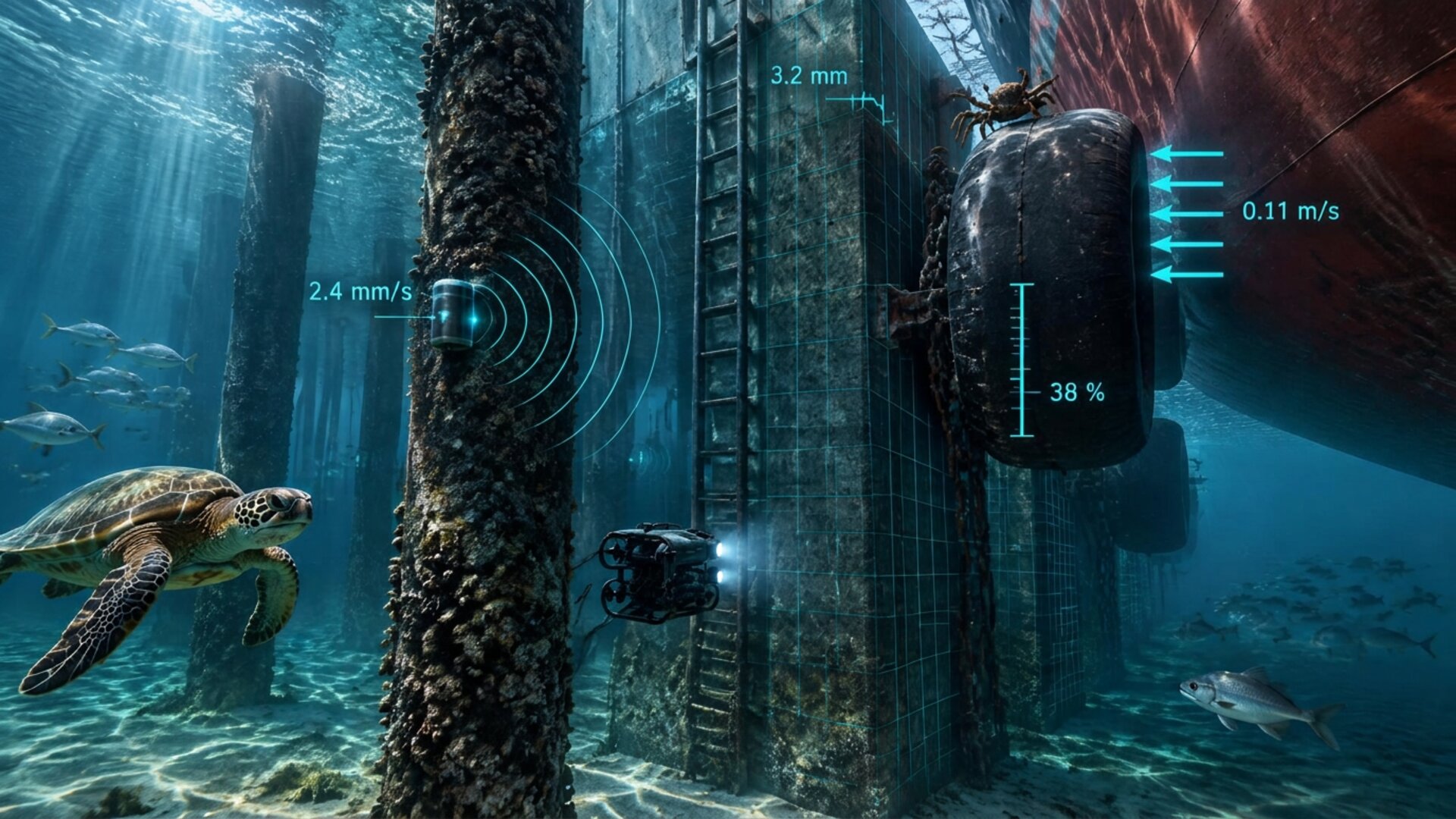
03Quay wall — structural strain, pile integrity and siltation, measured pile by pile. 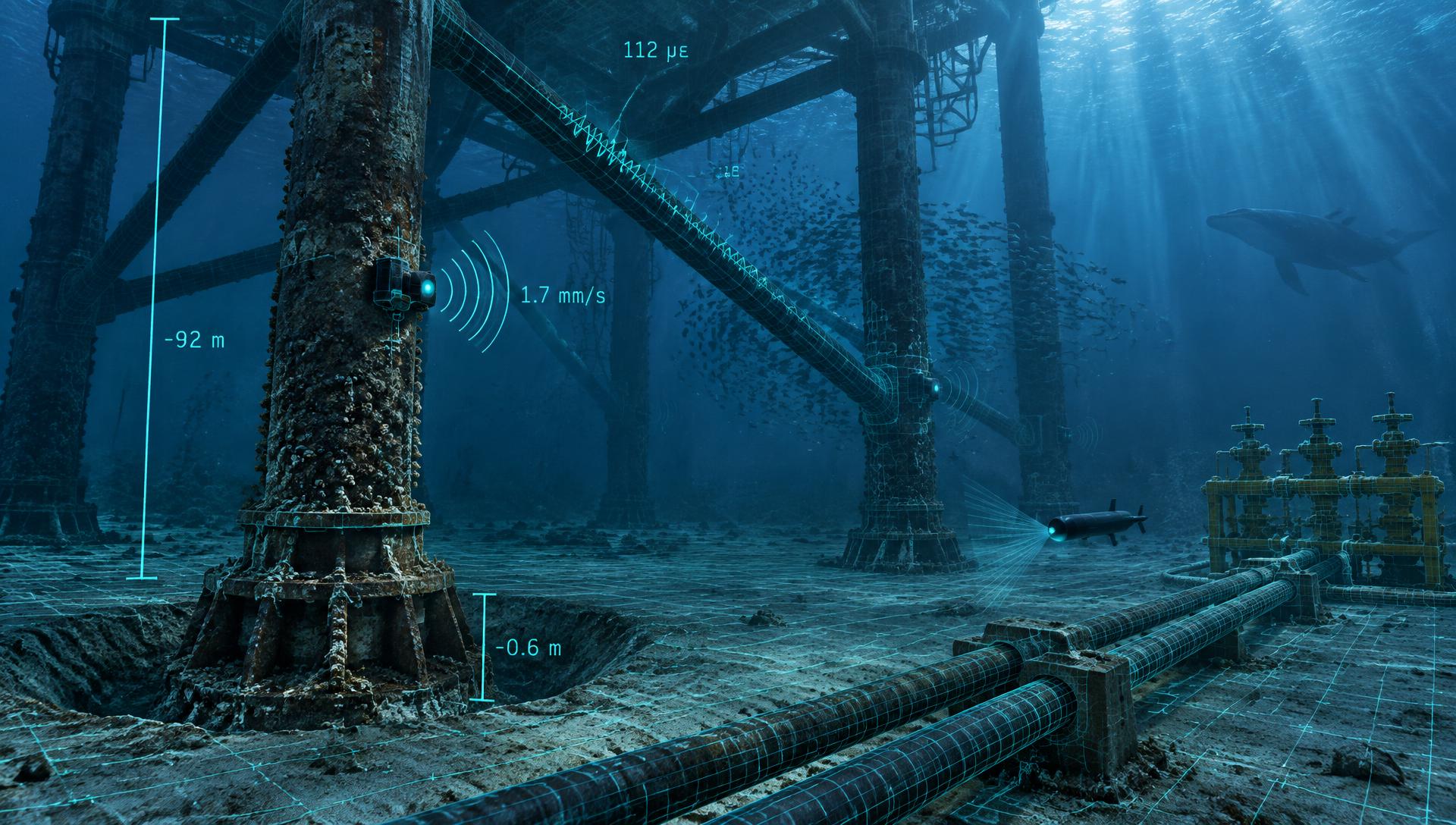
04Offshore pipelines under a platform — vibration, scour and integrity mapping. 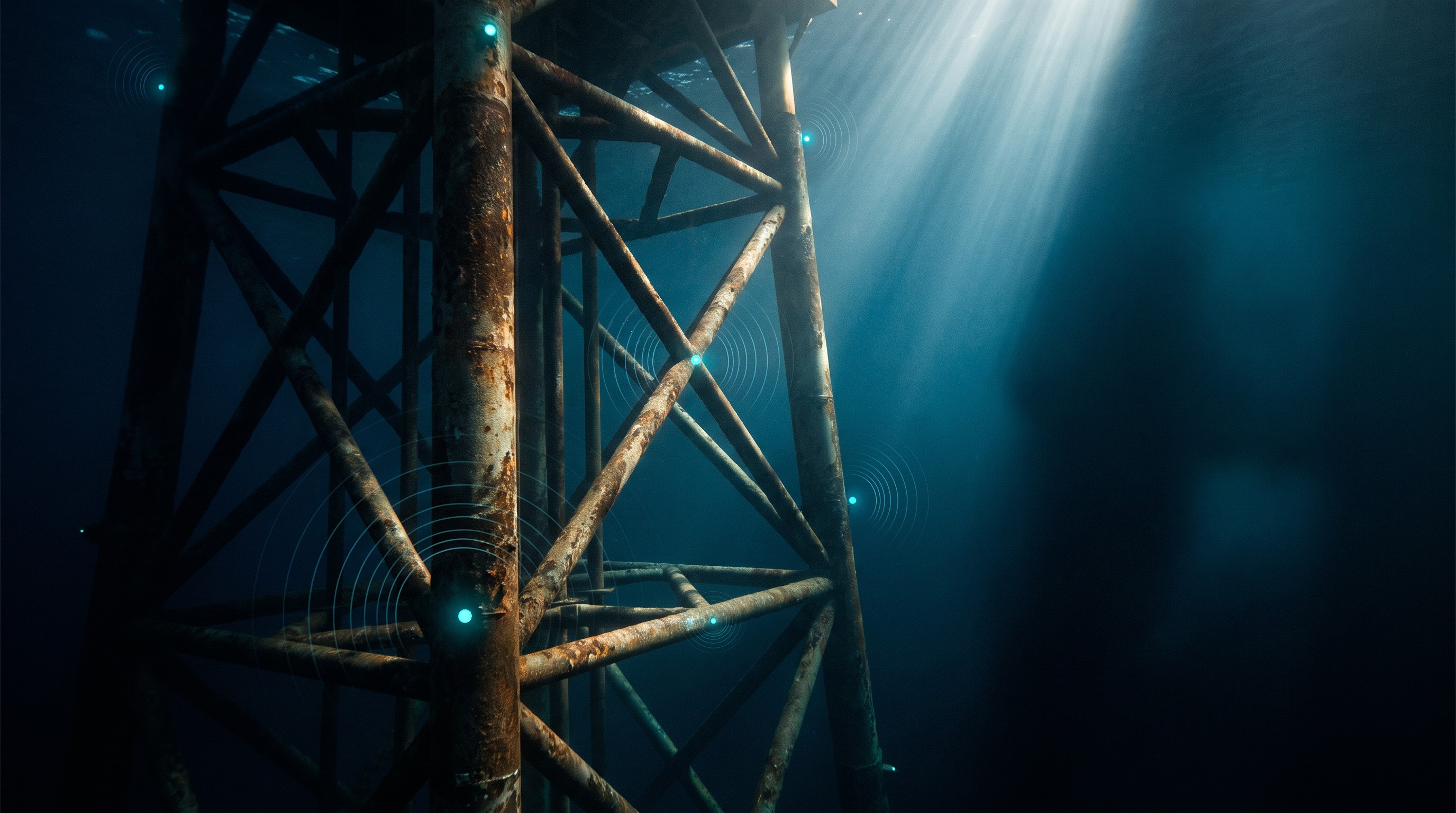
05Jacket legs — strain, corrosion and approach detection from sensor nodes on the structure. 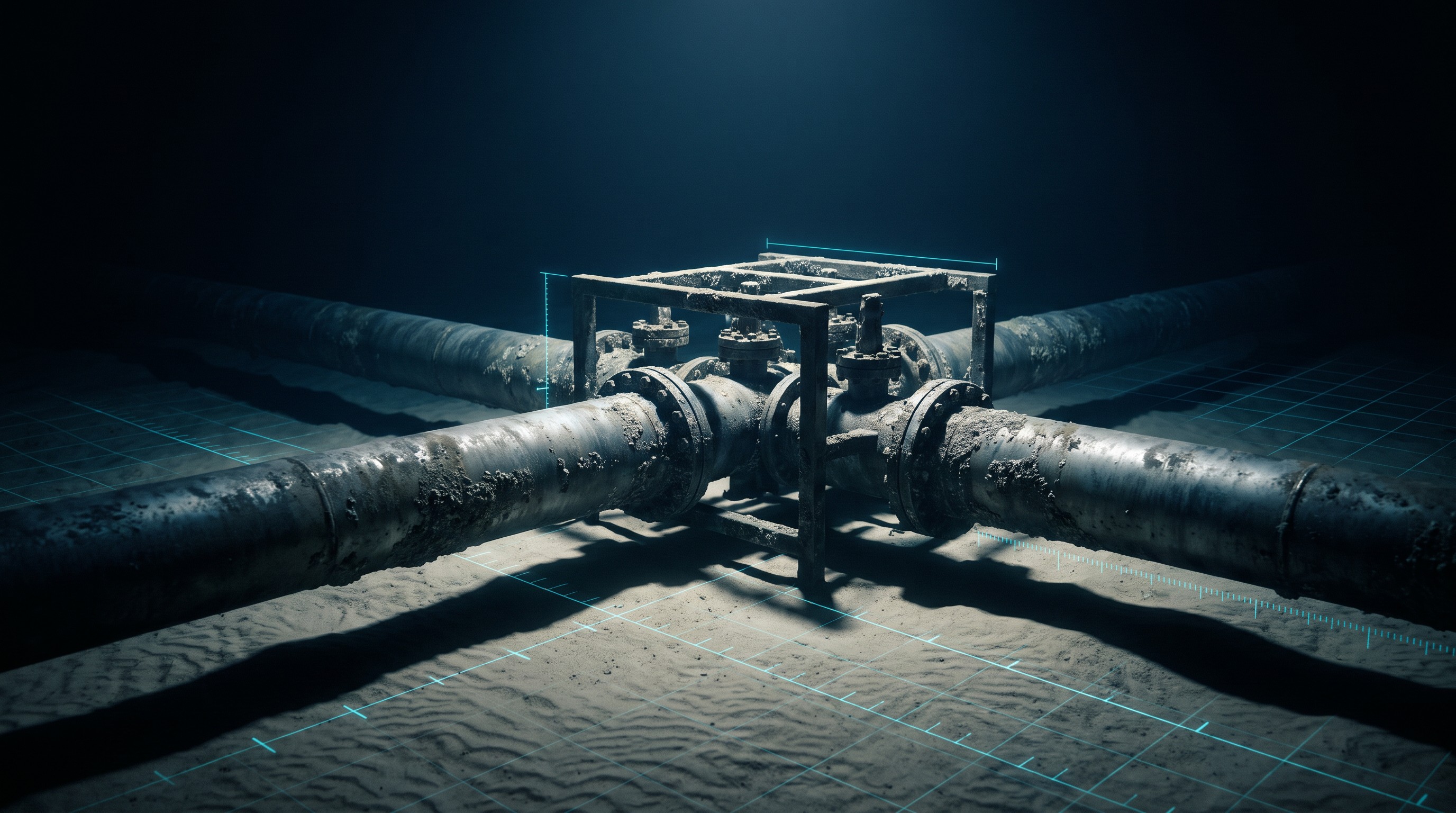
06Subsea pipeline and manifold — survey grid, sea-floor change and event detection. 07Channel bottom, from the units' point of view — several vessels verified, one flagged out of specification. 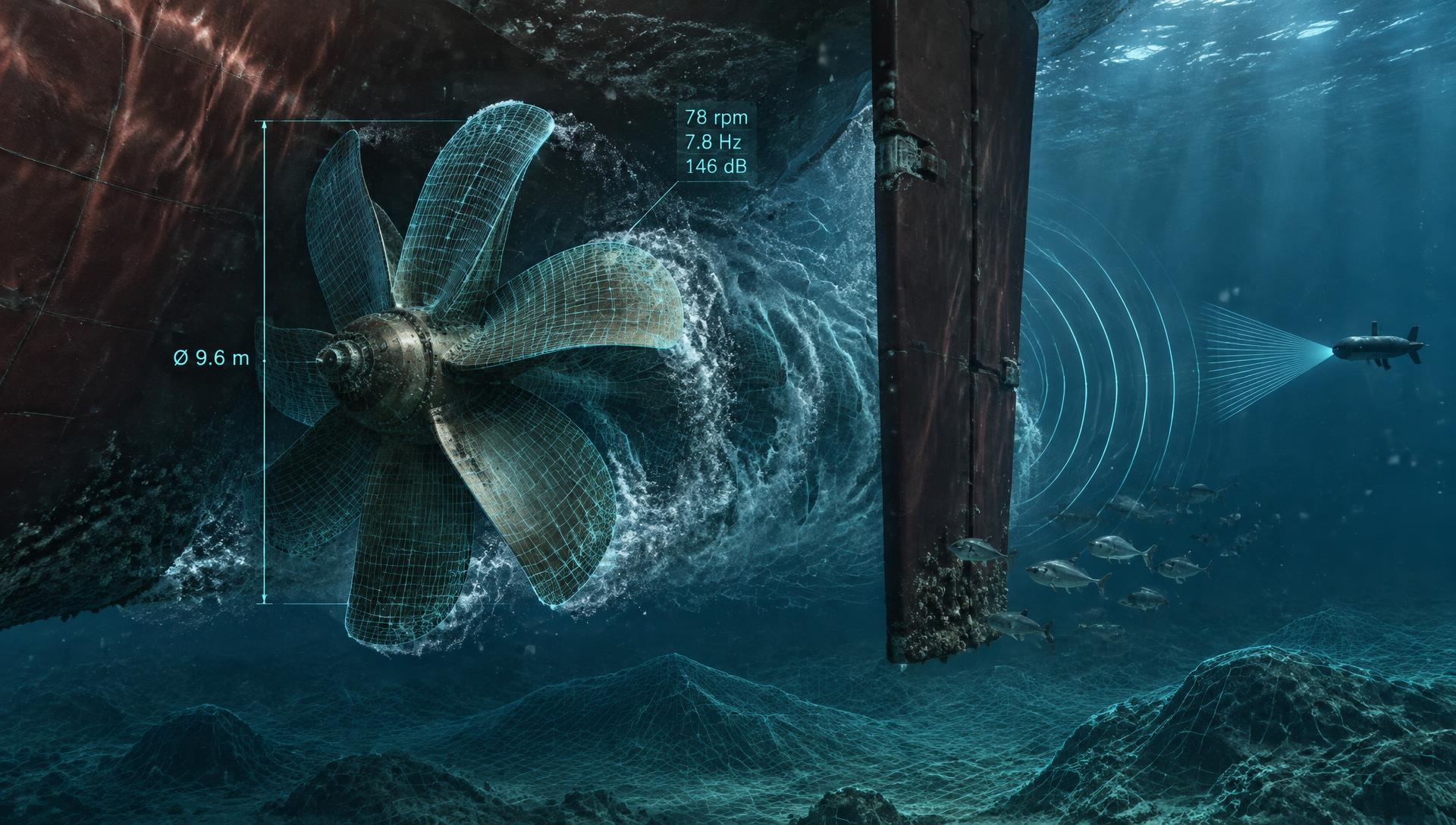
08Mega-ship propeller — noise and cavitation signature, wavefronts propagating astern. 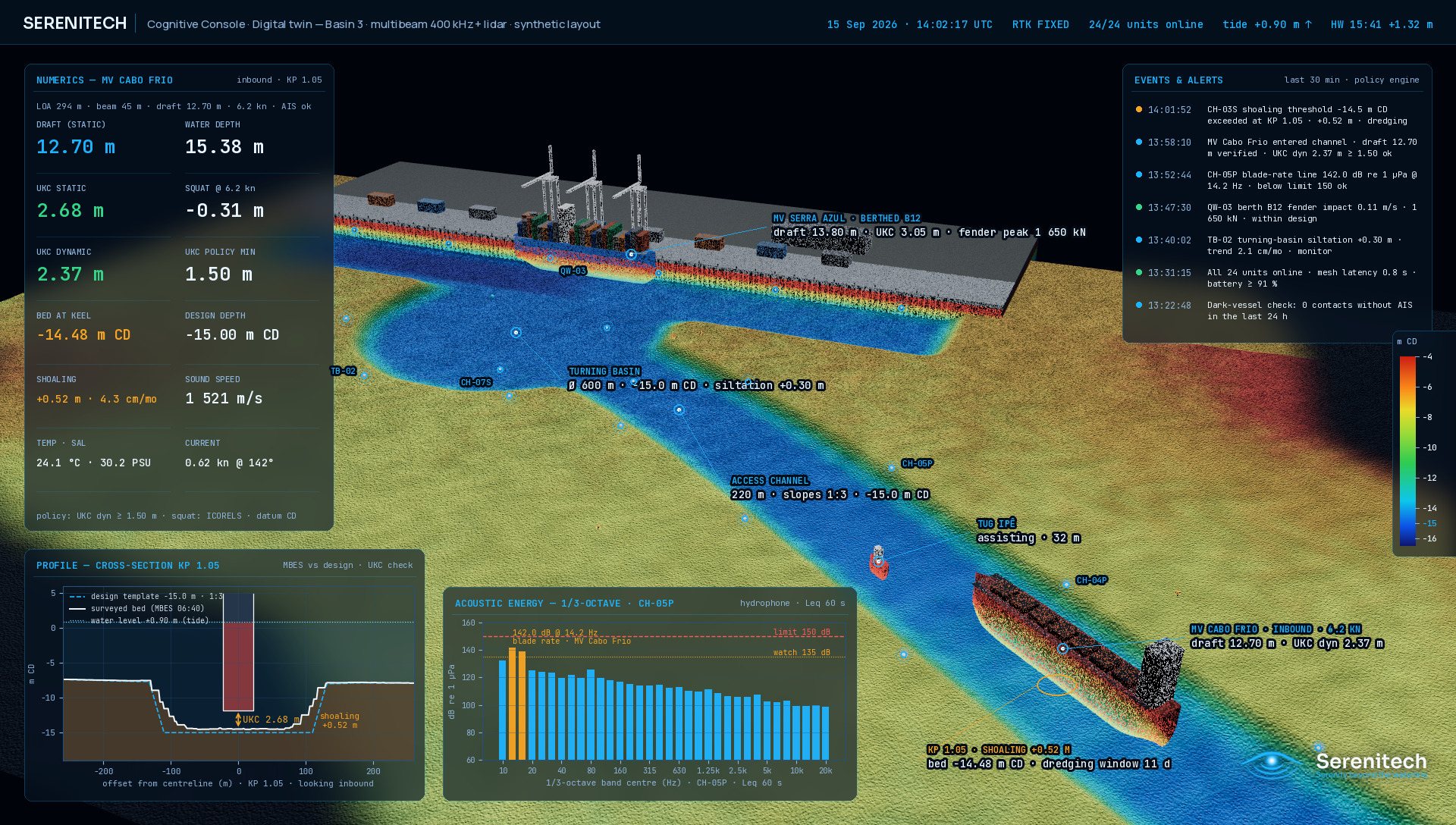
09Cognitive console — digital twin of a demonstration basin as a survey render: multibeam bathymetry and lidar point clouds with vessels and units, UKC numerics, cross-section, acoustic spectrum and events. 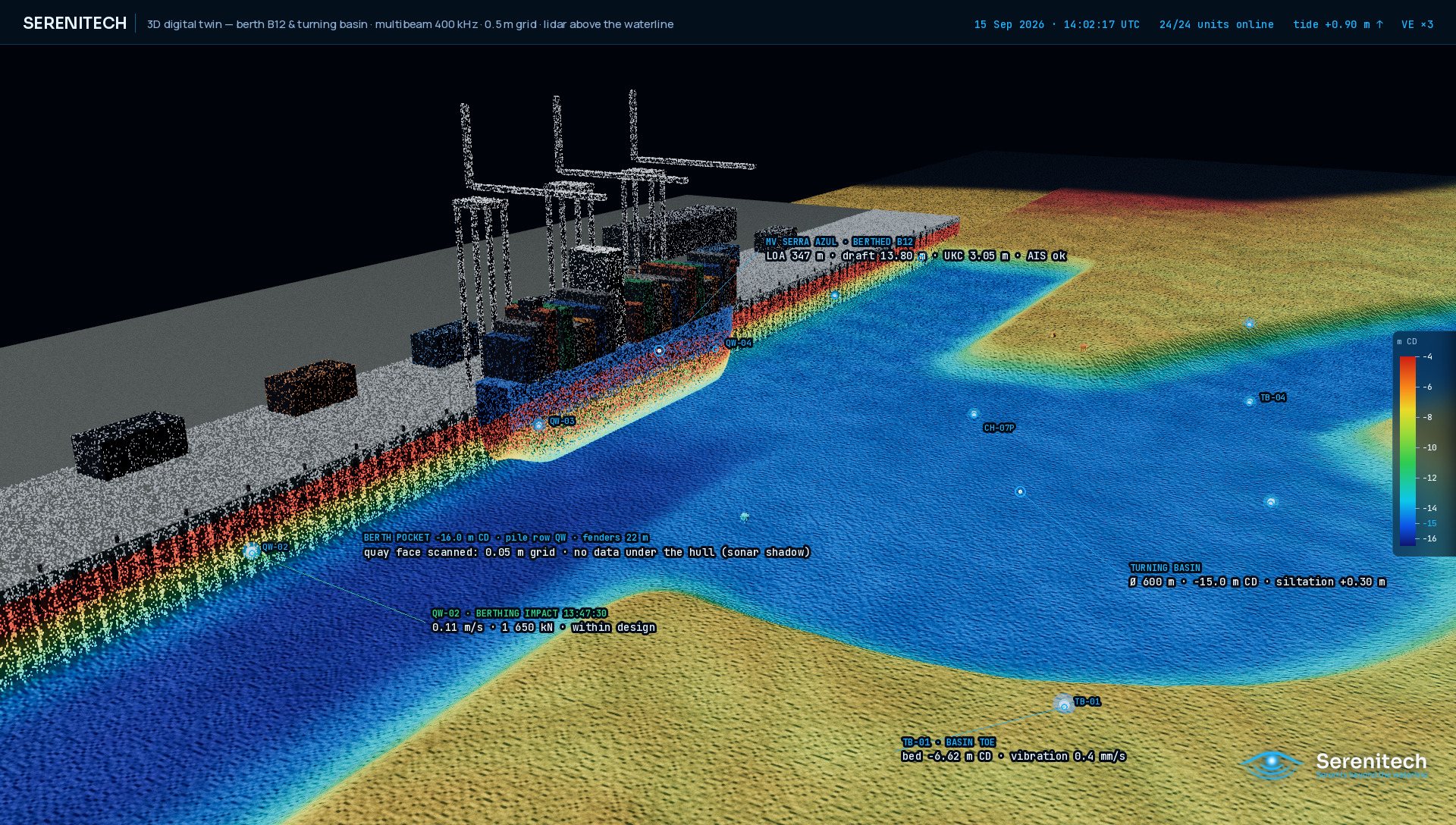
103D twin view — berth B12 and turning basin at −15.0/−16.0 m CD: quay face, berthed ship and cognitive units scanned on a 0.5 m grid (synthetic layout).
COGNITIVE SERVICES
Serenitech Cognitive Services
Serenitech Cognitive Services — the cloud layer of our AI cognitive robotics system: a unified, cloud-native platform that turns high-technology sub-surface physical phenomena into granular, real-time operational data streams. Continuous, online supervision of the critical infrastructure: access channel, manoeuvring basins, berthing piers — and, for offshore and subsea operators, the critical structure itself. Every module is engineered under a technical direction with 27 years of research in cross-medium telecommunications, underwater sensor networks, signal processing and edge AI — published at IEEE and protected by patent applications. When a situation calls for it, we also deliver tailor-made advisory.
Architecture mandate
Distinctly moving away from a decentralised, hardware-centric model, the service encapsulates all underlying instrumentation under abstract functional layers, served through low-latency secure APIs to control dashboards, real-time alert systems and a high-fidelity 3D spatial digital twin.
SERVICES
Serenitech Cognitive Services
- 01
Environmental Noise & Vibration Protection
Continuous underwater acoustic energy matrix and structural strain maps, with boundary-exceedance alerts per harbour sector.
Details - 02
Automated Digital Vessel Identification
Acoustic and hydrodynamic fingerprinting cross-referenced with AIS; instant dark-vessel alerts.
Details - 03
Predictive Siltation & Shoaling Intelligence
Siltation velocity vectors and volumetric deviation charts that prioritise dredging before thresholds are reached.
Details - 04
Dynamic Channel & Berth Draft Monitoring
Live vessel draft at bow, midship and stern, continuous under-keel clearance, squat and heel/roll analytics.
Details - 05
Structural Integrity & Berthing Impact Monitoring
Autonomous cognitive robotic units on critical structures — piers, dolphins, quay walls, jacket legs and subsea assets: displacement, vibration spectrum, shock and impact records.
Details - 06
Cloud Platform: APIs, Dashboards, Alerts & 3D Digital Twin
REST and streaming APIs, executive control dashboard, policy-enforcement alarm engine and a browser-based 3D twin of the harbour or asset.
Details
Module 01
Environmental Noise & Vibration Protection
What we measure
Continuous underwater sound-pressure levels across bands; micro-seismic and low-frequency mechanical energy propagating through piers and quay walls; water temperature and salinity profiles to compute local sound-speed vectors.
What you get
Real-time Acoustic Energy Matrix (dB re 1 µPa) updated across 1/3-octave bands from 10 Hz to 20 kHz; Structural Health Strain Maps with vibration amplitudes, velocity vectors and peak-particle-acceleration anomalies; immediate boundary-exceedance alerts linked to specific harbour sectors.
Why it matters
Proof of compliance with underwater noise limits, protection of marine fauna and structures, evidence for environmental reporting.
Module 02
Automated Digital Vessel Identification
What we measure
High-resolution broadband and narrowband acoustic emission signatures; blade-rate modulation frequencies (fundamental propeller signature); localised low-frequency hydrodynamic pressure signatures and the wake pattern induced by the moving hull.
What you get
Unique Acoustic Fingerprint Profile (engine firing rates, shaft RPM, blade count, harmonic peaks); Hydrodynamic Pressure Profiles estimating hull size, draft and speed; Multi-Influence Verification Matrix cross-referencing real-time footprints with mandatory AIS data; instant Dark Vessel Alerts when unauthorised or silent vessels cross spatial boundaries.
Why it matters
Security of the access channel and restricted zones, verification of declared traffic, forensic record of every movement.
Module 03
Predictive Siltation & Shoaling Intelligence
What we measure
Multi-frequency acoustic backscatter mapping suspended sediment; full-swath bathymetric depth matrices across channels and berthing pockets; local flow velocities and bottom shear-stress vectors.
What you get
Siltation Deposition Velocity Vectors predicting cubic metres of accumulation per grid coordinate per unit time; real-time volumetric deviation charts against historical baselines; automated critical dredging alerts prioritising zones approaching regulatory safety thresholds.
Why it matters
Dredging planned on prediction rather than on periodic surveys — lower dredging cost, no surprise shoaling, documented safety.
Module 04
Dynamic Channel & Berth Draft Monitoring
What we measure
High-density vertical distance matrices between hull and active channel bed; multi-point hydrostatic pressure gradients along the hull; dynamic tidal elevation, water density and wave-induced vertical motion.
What you get
Real-time dynamic vessel draft at bow, stern and midship; continuous Under-Keel Clearance (UKC) safety margins as the ship transits; squat effect and heel/roll analytics; spatial grounding-hazard predictions mapping low-clearance hot spots.
Why it matters
Safer transits, tighter draft windows, more cargo per call — with the evidence to support every decision.
Module 05
Structural Integrity & Berthing Impact Monitoring
What we measure
Autonomous cognitive robotic units fixed to piles, dolphins, fenders, quay walls, mooring structures, jacket legs, risers and subsea assets — three-axis acceleration, angular motion and displacement, shock/impact detection, full vibration spectrum and modal analysis; data carried by underwater wireless links to surface gateways (cellular, satellite or long-range low-power radio) with multi-year autonomy.
What you get
Displacement and drift trends, fatigue and modal signatures, timestamped impact records that identify the responsible vessel in docking collisions, threshold-based anomaly alerts, direct SCADA integration.
Why it matters
Liability and insurance evidence, fewer unplanned repairs, integrity management for critical structures no diver inspects every day.
Module 06
Cloud Platform: APIs, Dashboards, Alerts & Digital Twin
APIs
Developer-centric REST endpoints for structural queries and WebSocket streams for real-time applications; instant integration into VTMIS, SCADA, ERP and PMS.
Executive Control Dashboard
Multi-tenant view of port health — ambient noise indexes, berths within safe UKC, dredging priorities, vessel movement logs.
Smart Event Alarms & Policy Enforcement Engine
Low-latency rules pushing visual, SMS and webhook alerts — environmental violations, security events, safety hazards.
3D Spatial Digital Twin
Interactive browser-based model with volumetric bed renders, dynamic vessel blocks and sub-surface wavefront overlays.
GET /v1/channel/bathymetry/mesh
{ "grid_id": "basin_3", "mean_depth_m": 16.42, "siltation_volume_m3": 1420.5, "critical_alert": false }

GET /v1/vessels/signatures/classify
{ "confidence_score": 0.98, "detected_blade_rate_hz": 14.2, "ais_mismatch": true, "classification_tags": ["Dark Vessel", "Capesize Bulk Carrier"] }

GET /v1/environment/acoustic/streams
{ "sector_id": "ch_north_02", "spl_db": 142.3, "frequency_spectrum": { "63hz": 138.1, "125hz": 132.4 } }
Module 07
Advisory & Consulting — engineered case by case
Every port, platform and critical structure is different. Our advisory work is designed case by case by the team that builds the cognitive robotic units, the AI and the underwater links, under the direction of Dr. Thierry Deschamps de Paillette — agrégé, doctor in high-frequency electronics, photonics and systems, 27 years of research in cross-medium telecommunications, underwater sensor networks and edge AI, IEEE author and reviewer. International-level expertise in AI, deep tech and underwater connectivity in demanding conditions, applied to your situation.
Applicability & feasibility studies
Can your channel, terminal, platform or subsea asset be perceived continuously, and what for? We map the phenomena that matter, the units and positions required, the expected data quality and the business case — before any deployment.
Environmental impact review
Underwater noise and vibration assessments for dredging, piling, construction and traffic; baseline campaigns, monitoring plans and the continuous evidence regulators and licensing bodies require.
Structural & operational risk assessment
Berthing and mooring impact studies, dynamic draft and under-keel-clearance policies, siltation and dredging strategy, integrity plans for piers, dolphins, jackets, risers and pipelines.
AI & deep-tech architecture advisory
Independent review and design of sensing, edge-AI, cloud and digital-twin architectures; data strategy, integration with VTMIS, SCADA and ERP, cybersecurity and data governance.
Underwater connectivity in demanding conditions
Design of acoustic and optical links, autonomy and survivability of units in silt-laden, high-traffic and deep-water conditions, deployment and maintenance engineering.
Specification, procurement & owner's engineer
Technical specifications, vendor evaluation, acceptance testing and independent supervision of monitoring programmes, to international standards.
COMMERCIAL MODEL
Monitoring-as-a-Service
Monitoring-as-a-Service subscription — cognitive robotic units installed, owned and maintained by Serenitech; open-book pricing at local market conditions; engineering studies and technology development available as consulting.
TAILOR-MADE ADVISORY
Consulting engineered for your critical infrastructure, not for the average port.
Applicability and feasibility studies, environmental impact reviews, structural and operational risk assessments, AI and deep-tech architecture advisory, underwater connectivity in demanding conditions — delivered case by case, at international level, under a technical direction with 27 years of research in underwater telecommunications, sensors and embedded AI.
See the advisory services- Applicability & feasibility
- Environmental impact review
- AI & deep-tech architecture
HOW WE WORK
From feasibility study to continuous service.
- 01
Audit & feasibility consulting
A customised project for your channel, basin, berths or asset: strategic diagnosis of the operation, improvement opportunities, objectives and KPIs, measurement plan and viability assessment — the basis of the definitive project and the services-contract proposal.
- 02
Robotic deployment
Cognitive robotic units, underwater and on the surface, installed, operated and maintained by Serenitech; no capex for the operator.
- 03
Cloud activation
APIs, dashboards, alert policies and the digital twin connected to your VTMIS, SCADA or ERP.
- 04
Continuous service
24/7 monitoring, model updates, environmental and integrity reports — as a subscription under the services contract.
SECTORS
Four sectors, one sub-surface platform.
Ports & Terminals
Access channel, manoeuvring basins and berths — the port's critical infrastructure — under continuous, online sub-surface supervision: dynamic draft and UKC, predictive siltation, environmental noise compliance, vessel verification and berthing-impact records. Integrates with VTMIS and port ERPs.
OutcomeSafer transits, optimised dredging, documented compliance, fewer disputes.
Offshore Oil & Gas
Critical structures — jacket legs, risers, mooring systems and subsea equipment — supervised online for motion, vibration, impact and scour; approach detection of unidentified vessels around the platform; underwater noise monitoring during drilling and construction.
OutcomeIntegrity management with continuous evidence, security perimeter beyond the surface, environmental compliance.
Subsea Structures
Critical subsea infrastructure — pipelines, manifolds, cables, outfalls and offshore-wind foundations: structural motion and vibration, sea-floor change and sediment dynamics around the asset, event detection and long-term drift — from cognitive robotic units that need no diver visit for years.
OutcomeFewer inspection campaigns, earlier warnings, a digital twin of the asset on the sea floor.
Naval Industry
Shipyards, fleets and naval engineering: underwater radiated noise and acoustic signature measurement of hulls and propellers, signature drift as a condition indicator, basin and dry-dock monitoring, structural instrumentation of hulls and berthing structures — grounded in two decades of signal-processing and underwater-telemetry research.
OutcomeMeasurable acoustic performance and continuous data for design, maintenance and certification support.
TECHNOLOGY
From the sea floor to the API.
Serenitech is an AI cognitive robotics system: units that perceive, reason and act, orchestrated by a cloud cognitive engine. Its architecture descends from two decades of research on underwater telecommunications and sensor networks and from the European AI programmes AI4DI and EdgeAI.
Five layers
Interfaces
REST and WebSocket APIs, executive dashboards, alarm and policy engine, 3D digital twin.
Cloud engine
Ingestion optimised for massive time-series arrays and spatial data; processing fully decoupled from the harbour hardware; multi-tenant, scalable, secure.
Edge intelligence
Each unit reasons locally: frugal AI models classify events where they occur, cutting bandwidth and latency.
Connectivity layer
Underwater wireless links (acoustic and optical) to surface gateways; cellular, satellite and long-range low-power radio backhaul; store-and-forward resilience.
Robotic sensing layer
Cognitive robotic units carrying hydro-acoustic arrays, inertial and vibration sensing, pressure and distance matrices, echo-sounding and water-column probes (temperature, salinity, turbidity), fixed on structures or deployed in the channel.
DIGITAL TWIN
A living 3D model of your harbour — from the bottom up.
- Colour-coded bathymetric surface with siltation density and critical shallow zones
- Dynamic vessel blocks with real-time draft, pitch, roll and heel
- Sub-surface wavefront overlays locating acoustic and structural events
- All rendered in the browser, fed by the same APIs your systems use
- UKC dynamic2.68 m
- Tide+0.90 m
- Inbound vessel6.3 kn
- Blade rate 14.2 Hz142.3 dB
- MBES pings · units13/s · 24/24
AI STACK
Deep tech, built in-house.
Frugal edge AI inside every cognitive robotic unit — classification where the signal is born.
Physics-informed models — acoustics, hydrodynamics and structural mechanics guide the learning.
Layered intelligence — unit → gateway → cloud, resilient to intermittent links.
Federated learning and over-the-air model updates across sites.
Security by design — encrypted links, signed measurements, role-based access, full audit trail.
Research lineage — doctoral work in signal and image computing and in high-frequency electronics, IEEE OCEANS and EuCAP publications on high-data-rate underwater sensors, and the European EdgeAI programme behind our edge-intelligence design.
SECURITY & DATA GOVERNANCE
Security & data governance
Encrypted links end to end
Signed measurements with immutable audit trail
Role-based access per tenant and sector
Data residency options per country
Integration behind the operator's firewall on request
RESEARCH DNA
Research DNA
High-frequency electronics, photonics, underwater telecommunications, signal processing and AI — a laboratory culture in Monaco and Florianópolis dedicated to the sub-surface environment, rooted in 27 years of research: doctoral work at the L3i laboratory (La Rochelle) and at Orléans, IEEE OCEANS and EuCAP publications on high-data-rate underwater sensors and antennas, reviewing for the IEEE Journal of Oceanic Engineering, two patent applications on AI-driven underwater communication, and the European AI programmes AI4DI and EdgeAI.
COMPANY
A global deep-tech group dedicated to the sub-surface world.
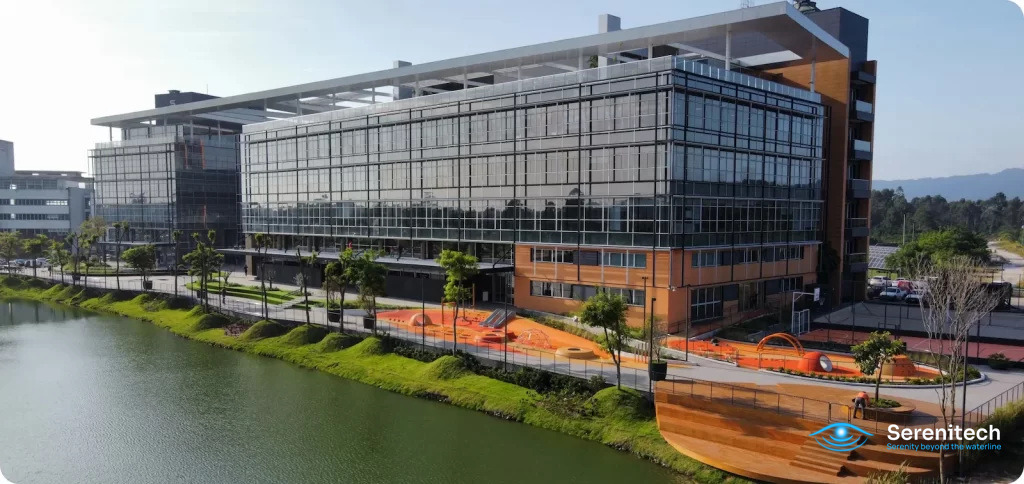
Much of the world's critical infrastructure sits partly under water, and it is supervised almost blind. Serenitech builds the AI cognitive robotics — sensing, connectivity, artificial intelligence and cloud services — on three decades of research in underwater telecommunications, sensors and embedded AI, giving port authorities, offshore operators, subsea asset owners and the naval industry continuous sight, memory and foresight beyond the waterline. The name says it: serenity through technology.
TECHNICAL & SCIENTIFIC DIRECTION
Three decades of research in underwater sensing, telecommunications and embedded AI — at the head of our engineering.
Serenitech is a specialised technical-services company. Its technology, laboratories and product architecture are directed by Dr. Thierry Deschamps de Paillette — agrégé in electrical engineering and electronics, doctor in high-frequency electronics, photonics and systems, with doctoral research in signal and image computing, and 27 years of advanced research applied to cross-medium telecommunication systems, underwater sensor networks, signal processing and edge AI. Industrial products, IEEE publications, patent applications and the European AI programmes AI4DI and EdgeAI form the technical foundation of every service on this page.
- 27 yearsof advanced research — high-frequency electronics, photonics, systems and AI
- Agrégé · Ph.D.France's most selective national examination in the discipline; doctorate awarded with félicitations du jury
- IEEEpublications at OCEANS and EuCAP; reviewer for the IEEE Journal of Oceanic Engineering
- 2 patent applicationsAI-driven selection of the underwater communication mode (EP · PCT), sole inventor
- AI4DI · EdgeAIEuropean AI programmes led with large industrial groups and startups
- 20 yearsof industrial product design — Crouzet, Micrelec, TECHNEXT
Dr. Thierry Deschamps de Paillette
Chief Technology Officer · Technical & scientific direction
Dr. Thierry Deschamps de Paillette is agrégé in electrical engineering and electronics — France's most selective national competitive examination in the discipline — and holds a doctorate from the Université de La Rochelle awarded with félicitations du jury, the highest distinction. He brings a 27-year track record in advanced research across high-frequency electronics, photonics and systems, applied to AI, cybernetics and cross-medium telecommunication systems in cooperation with large industrial groups. His recent research and engineering work covers a new generation of underwater telecommunication and sensor networks. He has designed industrial products for two decades — Crouzet, Micrelec, TECHNEXT — and is the named inventor on patent applications for AI-driven selection of underwater communication mode. A higher-chair professor within the French national academic system, he sat on the national boards that recruit agrégés in engineering sciences. He publishes at IEEE and reviews for the IEEE Journal of Oceanic Engineering, and as an AI advisor, speaker and expert in clusters including Institut EuropIA and Cluster-IA he led the European AI programmes AI4DI and EdgeAI with large industrial groups and startups. At Serenitech he leads technology, laboratories and product architecture — the cognitive robotic units, the underwater communication stack and the AI sensing and edge-intelligence layers.

GLOBAL PRESENCE
Global presence
Monaco
Group headquarters and laboratory; technology development and engineering.
Avenue J. F. Kennedy, Port Hercule98000 MonacoPrincipality of MonacoFlorianópolis, Brazil
Brazil headquarters with office and laboratory in Sapiens Parque, Brazil's largest technology park; operations for ports, offshore and naval clients in Brazil.
Avenida Luiz Boiteux Piazza, Sapiens ParqueFlorianópolis, SC, 88056-000BrazilCoral Gables, Florida, USA
North American operations.
Valencia AvenueCoral Gables, Florida, 33134United States of AmericaSerenitech Global Corporation
Holding company of the group and of all its subsidiaries.
HOW WE START
It starts with a strategic diagnosis of your operation.
A structured, budgeted consulting project, tailored to your channel, terminal, platform or asset and built on deep knowledge of how your operation really works. Its conclusions become the definitive project and the long-term services-contract proposal.
- 01
Strategic diagnosis
In-depth understanding of the current operation — routines, data, risks and constraints, as they actually happen.
- 02
Improvement opportunities
Where continuous sub-surface intelligence changes the outcome — located, quantified and prioritised.
- 03
Objectives & KPIs
The targets and indicators that will measure the definitive project, agreed with your team.
- 04
Definitive project
Development and deployment plan, budget and the services-contract proposal.